Call:
0 (800) 210-023

Mon-Fri: 9:00 - 18:00
Mon-Fri: 9:00 - 18:00
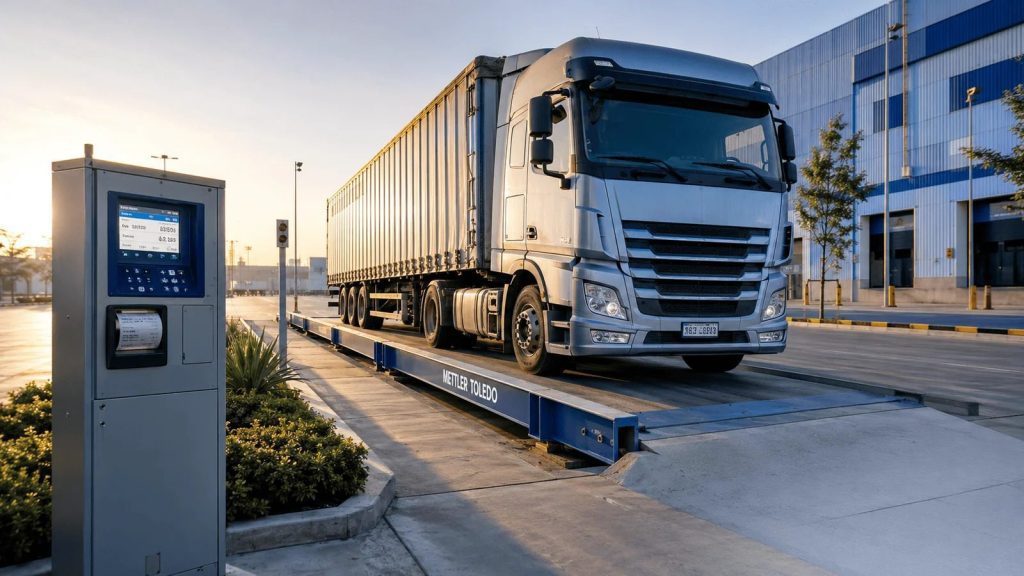
The profitability of modern automotive logistics is measured not only by freight rates but also by a company’s ability to meticulously comply with regulatory requirements. Today, with fully automated roadside enforcement and the human factor minimized, accidental overweight of a truck or improper distribution of goods among the axles of a semi-trailer instantly translates into severe financial penalties.
We will examine current legislation in detail, compare Ukrainian realities with European regulations, and provide practical recommendations on how to protect businesses from unexpected expenses.
In Ukraine, automated Weigh-in-Motion (WIM) systems have become a key tool for enforcing weight compliance. These systems weigh vehicles directly while they are moving, recording total weight, axle loads, dimensions, and axle distances.
Data from the sensors is instantly transmitted to the State Traffic Safety Inspectorate’s Data Processing Center. The inspector only needs to verify the automatically generated order and send it to the vehicle owner. A key legal detail often overlooked by shippers: joint liability is established for exceeding the limits set by the consignment note. This means that if the shipper knowingly or negligently provides false weight information in the documents, penalties may be applied to them as well, not just the carrier.
Administrative penalties in Ukraine are progressive. The amount of the penalty directly depends on the percentage of excess of the state-established limits. The law divides violations into five main categories.
Fines for Overload in Ukraine: Official Rates:
A fine is issued for each recorded violation. If an overloaded truck passes under three WIM frames on the highway, the carrier risks receiving three separate fines.
Many believe that if the gross vehicle weight of a road train is within the permitted 40-ton limit, the risks are eliminated. This is a dangerous misconception. Ukrainian inspectors and WIM systems impose equally severe fines for both overall overweight and incorrect axle distribution.
Let’s look at the key factors that trigger fines for axle overload:
Below is the official regulatory framework, violation of which entails penalties for overloading a truck:
Regulatory parameters for road transport in Ukraine:
| Vehicle Type / Axle Design | Maximum Permissible Load/Mass |
| Single Axle | Up to 11.5 tons |
| Double Axle (Axle Spacing 1.3-1.8 m) | Up to 16 tons for tandem axles |
| Triple Axle (Axle Spacing 1.3-1.4 m) | Up to 22 tons for triple bogie |
| Total Mass (Two-Axle Tractor with Three-Axle Semitrailer) | Up to 40 tons |
| Total Mass for Container Trucks (on designated routes) | Up to 44 tons (for single containers) |
Note: The Cabinet of Ministers’ Resolution clearly regulates weight standards. However, in practice, disputes with WIMs often arise for container shipping due to the specific configuration of container semi-trailers, requiring a detailed legal analysis of the consignment note.
Container shipping has found itself in a particularly vulnerable position. Current legislation stipulates an increased gross vehicle weight limit of 44 tons for container ships. However, automatic WIM systems are configured with standard algorithms.
As a result, the software often classifies standard container ships as regular road trains, automatically applying the base limit of 40 tons. This leads to the generation of erroneous fines for exceeding the gross vehicle weight, even if the carrier followed the agreed route and did not violate the law.
Similar problems arise when fines are issued for axle overload due to uneven weight distribution within a sealed sea container. The driver and transport company do not have physical access to the interior of the container to check the proper stacking of boxes or pallets, but the carrier is the primary subject of any penalties.
For Ukrainian logistics companies operating international routes, border crossings are subject to even stricter controls. In the European Union, weight controls, fines, and security measures are significantly stricter, and financial losses can amount to thousands of euros.
The EU is governed by Directive 96/53/EC, which establishes uniform dimensions and weight standards. However, the amount of fines and the procedures for imposing them are regulated by the national legislation of each individual country.
In Germany, fines for overweight cargo are imposed on both the driver and the owner of the transport company (Halter). Furthermore, the German police and BAG (Bundesamt für Freightforwarding) apply a zero-tolerance approach to safety.
In Poland, driving a heavy vehicle without a special permit carries administrative penalties that can reach tens of thousands of zlotys. The regulatory authorities (ITD) strictly monitor fines for exceeding axle loads and gross vehicle weight. In addition to the fine, the vehicle is towed to a guarded impound lot, and the carrier bears the full cost of towing and storage. The company’s transport manager also bears personal liability.
Italian law links fines for overweight cargo to the vehicle class and the risk to road infrastructure. The minimum fine starts at €400, but if systematic violations or overloading by more than 30% are detected, the amount immediately increases to €4,000. Additionally, police have the right to confiscate the vehicle’s registration certificate for up to three months.
To minimize the risk of receiving fines from the Ukrainian Transport Safety Agency (Ukrtransbezopasnost) or European regulatory authorities, Neolit Logistics experts recommend implementing four basic control rules into your operations.
Never rely solely on the figures stated on the international or domestic consignment note. If you have any doubts about the nature of the cargo, especially when transporting metal structures, building materials, or industrial equipment, request a preliminary weighing on the shipper’s certified stationary scale.
The driver must monitor the placement of pallets in the truck bed. There’s a simple rule: the load must be distributed evenly across the entire length of the platform. Having unused space in the front or rear of the semitrailer can lead to a fine (overloading) for the axles. Use modern onboard axle load monitoring systems that transmit telematics data to the dispatcher in real time.
The consignment note must clearly indicate the exact vehicle parameters, including the number of axles and tare weight. In the event of legal disputes with the State Transport Inspectorate due to incorrect operation of the WIM systems, a properly executed consignment note and weighing report from the loading point will be your primary evidence in court.
For specialized cargo (containers, heavy equipment, bulk chemicals), specialized vehicles are required. Specialized semi-trailers with increased axle spacing or additional lifting axles (“idlers”) allow for the legal transportation of maximum cargo volumes, reducing point pressure on the road surface.
Cooperation with proven operators, such as Neolit Logistics, guarantees clients strict compliance with all regulatory requirements both in Ukraine and abroad. An expert approach to forming consignments, precise calculation of axle loads, and detailed knowledge of international transport law ensure cargo is delivered on time, safely, and without unnecessary financial losses on the road.
Leave your contacts to contact our specialist.